The architect of the Finsbury Bank for Savings
Alfred Bartholomew 1801–1845
Alfred Bartholomew designed one building of note, the Finsbury Bank for Savings in Sekforde Street, and could not build it as he wanted. His lasting work was on paper: a combative book arguing that good architecture, and Gothic above all, is structural through and through.
- Born
- London, 28 March 1801
- Died
- Gray’s Inn, 2 January 1845, aged 43
- Architect of
- the Finsbury Bank for Savings, 1839–41
- Author of
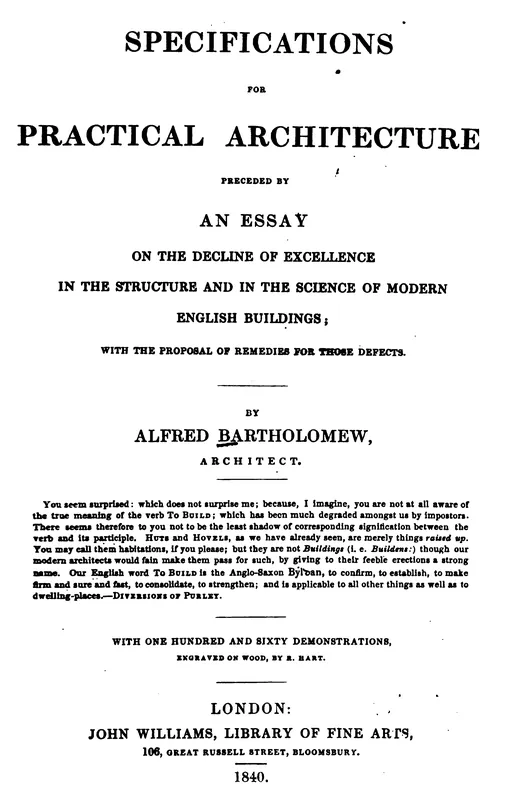
- Specifications for Practical Architecture, 1840
- Editor of
- The Builder through 1844
- Portrait
- None known
Eleven chapters
- “In politics a conservative, and in religion a churchman, … is obliged to confess himself in architecture an uncompromising radical.”Alfred Bartholomew, 1839Chapter 1, 1801–c.1817The watchmaker’s son
- “Wren had more science in his head and heart, than a thousand Sir John Soanes in their whole souls and bodies”Alfred Bartholomew, 1840Chapter 2, c.1817–c.1821Early mornings at the Bank of England
- “His private practice did not afford works of sufficient importance for further notice”Architectural Publication SocietyChapter 3, 1831–38Thirty-two buildings, none of them named
- Chapter 4, 1838–39Enormous fire-grates
- Chapter 5, 1839–41Paying for his own ornament
- Chapter 6, 1840The bank he published instead
- Chapter 7, 1840A Society of English Plasterers
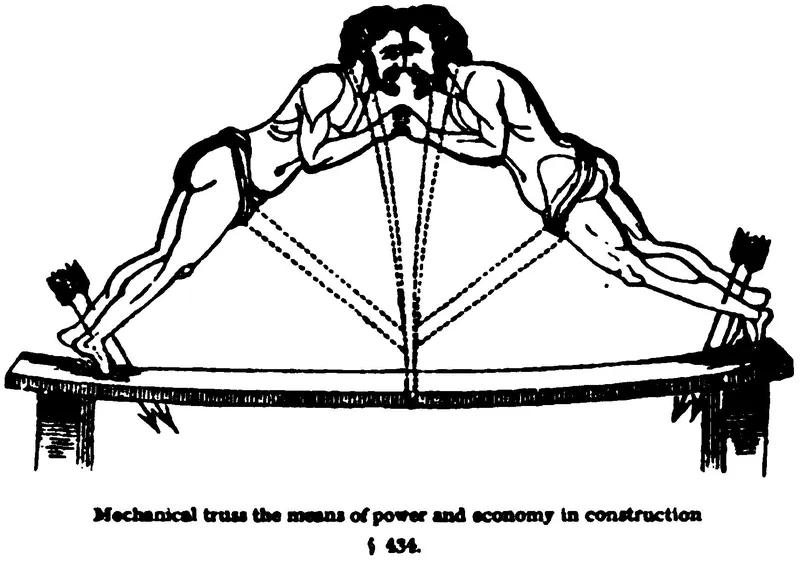
- “Bartholomew, my boy! we are now quits: you are a d— honest, plain-speaking, though somewhat hard-mouthed fellow,—one who does not mince matters at all.”“Candidus”, 1840Chapter 8, 1839–44Candidus and “Caninus”
- “But let us become once more Real Free-masons, and we shall have ribbed vaults, and domes, built of stone for the price of our present mean and perishable wooden skeleton-work”Alfred Bartholomew, 1840Chapter 9, 1842–44Real Free-masons
- Chapter 10, 1844–45One day in office
- “… built little and nothing of great importance. His importance lies entirely in one book”Nikolaus Pevsner, 1972Chapter 11, 1845–2008From standard book to pioneer
Timeline
- Told in these chapters
- Told on the history pages
- 1801, 28 MarAlfred Bartholomew born in London
- 1816Finsbury Bank for Savings foundedThe building
- c.1817Bartholomew articled to J. H. Good, a former pupil of Soane
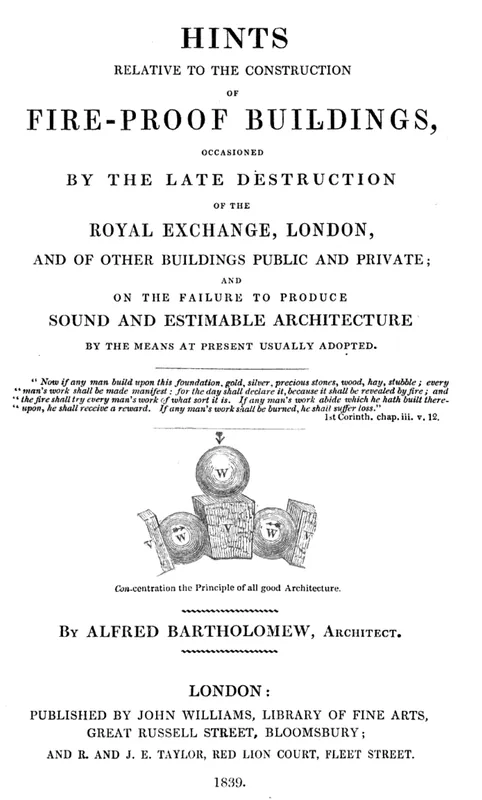
- 1839, AprHints relative to the Construction of Fire-proof Buildings reviewed
- 1839Site in Sekforde Street agreed; building begins, in mid-May according to the Survey of LondonThe building
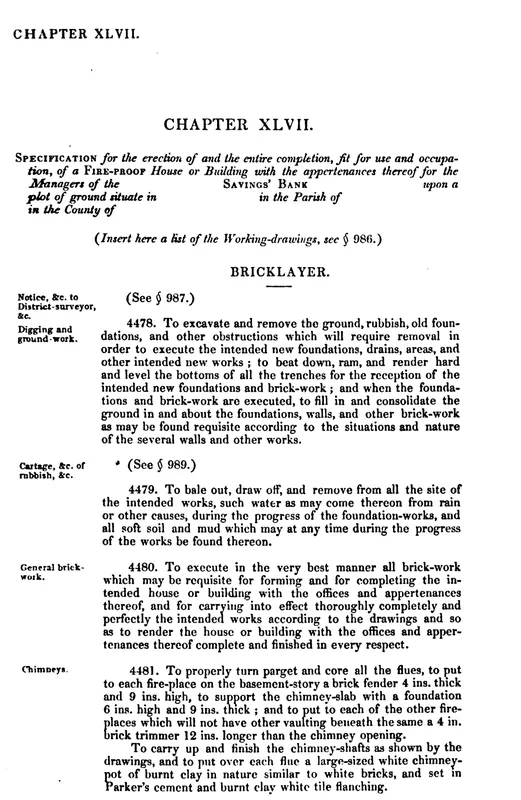
- 1840Specifications for Practical Architecture published, with a fire-proof savings bank as Chapter XLVIIThe building
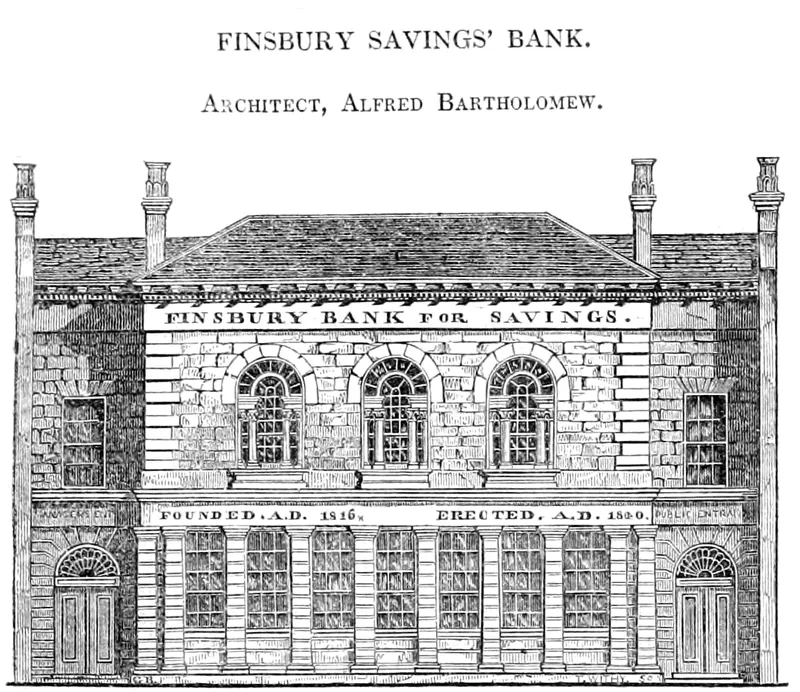
- 1840, JulThe CEAJ publishes the front: “only £2850” allowed, and the architect pays for part of the ornamentThe building
- 1841, AprThe bank at work in Sekforde StreetThe building
- 1842, 26 NovBartholomew founds the Freemasons of the Church
- 1844Bartholomew edits The Builder
- 1844, 28 NovElected district surveyor for Hornsey
- 1845, 2 JanBartholomew dies at Warwick House, Gray’s Inn, aged 43The building
- 1942, 21 MayThe Finsbury and City of London Savings Bank merges with the London Savings Bank to form the London Trustee Savings BankThe building
- 1942, OctGeorge G. Pace calls Bartholomew “a pioneer of functional Gothic”
- 1950, 29 DecThe bank listed at Grade IIThe building
- 2021–22Front repainted to Bartholomew’s specification, in Portland stone and purple brown, and the entrance lettering reinstatedThe building
Picture credits
- This pageA. Bartholomew, Specifications for Practical Architecture (1840), NYPL copy digitised by Google, via Internet Archive. Public domain (1840). Source.
- Chapter 4A. Bartholomew, Hints … (1839), British Library copy digitised by Google. Public domain (1839); Google Books scan of the British Library copy. Source.
- Chapter 5The Civil Engineer and Architect’s Journal, vol. III, July 1840, p. 217; engraved by T. Withy. Internet Archive / Northeastern University Library. Public domain (1840). Source.
- Chapter 6A. Bartholomew, Specifications for Practical Architecture (1840), NYPL copy digitised by Google, via Internet Archive. Public domain (1840). Source.
- Chapter 6A. Bartholomew, Specifications for Practical Architecture (1840), NYPL copy digitised by Google, via Internet Archive. Public domain (1840). Source.
- Chapter 7Woodcut by R. Hart, Specifications (1840). Public domain (1840). Source.
- Chapter 10The Builder, 13 January 1844. Public domain (1844). Source.

The photographs are reproduced under the Creative Commons licences named. The cropped versions of No Swan So Fine’s photographs are shared under the same licence, CC BY-SA 4.0. Quotations from works still in copyright are kept short and attributed, and each chapter’s notes give its sources.