Chapter 5 of 111839–41
Paying for his own ornament
How Bartholomew came to be chosen is not recorded, and there is no evidence of a competition (the commission). What is recorded is a disappointment. He had prepared “a larger and superior building, to be finished externally with Portland stone … and with the novelty of an entire fire-proof construction”. The sum allowed was “only £2850”, and the building was “neither built externally of the materials, nor finished internally in the style, which the architect of it desired” (construction). According to the Survey of London, the bank’s committee would not pay for the stone or the fire-proofing.
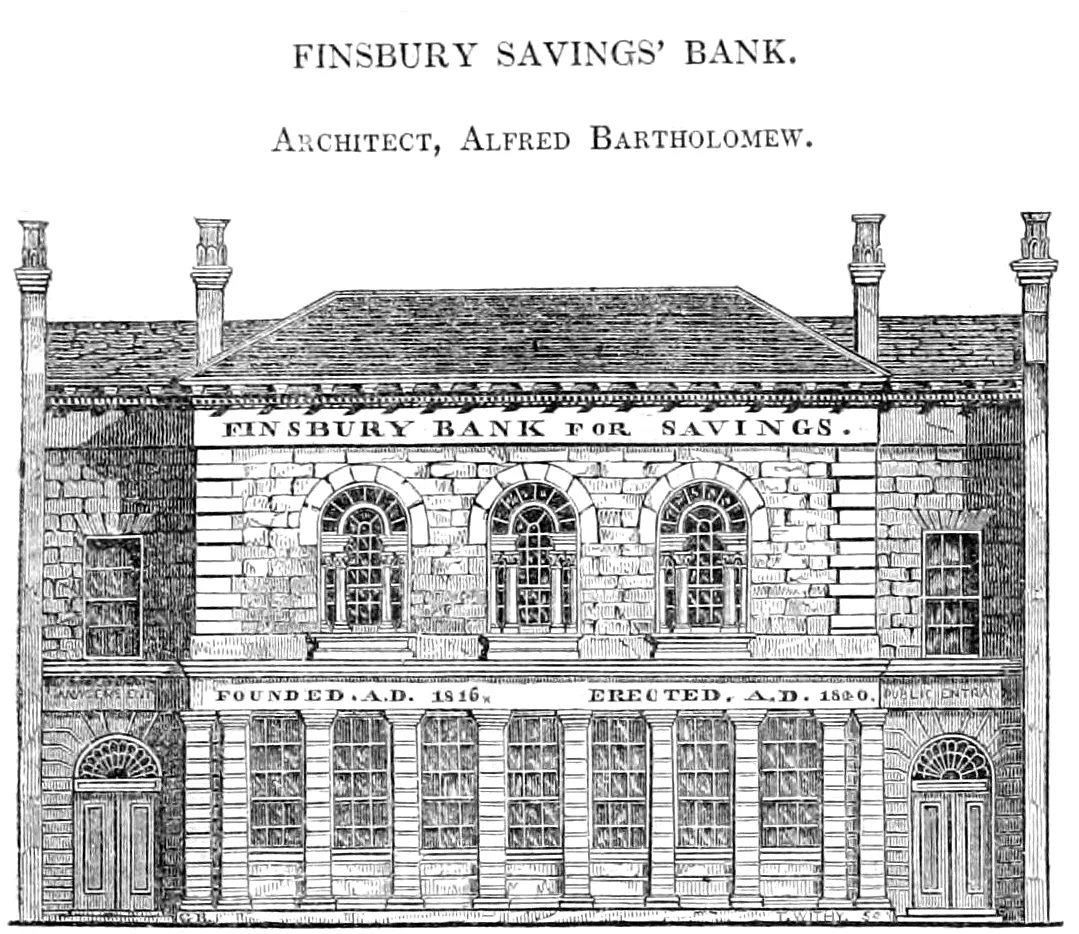
Bartholomew’s answer was to pay for part of the ornament himself. In the words of the Civil Engineer and Architect’s Journal, “the architect chose to be at some part of the expense of the external decorations of it, rather than suffer it to undergo farther mutilation”.
The result is the stuccoed Italianate front that still stands. Its fascias were made broad “for the purpose of receiving inscriptions to be visible at a considerable distance” (the building described). Its end bays held two entrances: the manager’s on the left and the depositors’ on the right (the entrances). The Survey calls it “a showy Italianate style, thought appropriate for banks” (reception). The bank was working there by April 1841. It was to be his only significant building.
Notes
- No source records how he came to be chosen. The Survey of London, drawing on the letter-books of James Noble, who by the late 1830s handled the Seckford estate’s day-to-day building work, says that he “soon settled the ‘Style and substantial Character’ of the bank with James Noble” (vol. 46, p. 82, para [p80] and fn. 48; the letters were not seen).
- CEAJ, vol. III, no. 34, July 1840, p. 217, “Finsbury Savings’ Bank. Architect, Alfred Bartholomew.” (https://archive.org/details/civilengineerarc03lond, page n252). The Survey of London dates this design “a few years earlier”; the CEAJ, its only source, gives no date.
- CEAJ (July 1840), p. 217. The £2,850 was an allowance, not a final account; no final cost is known.
- Survey of London vol. 46, p. 82, para [p81] and fn. 50. The CEAJ itself does not mention the committee.
- CEAJ (July 1840), p. 217 (two scans agree on “farther”). The Survey of London’s paraphrase (p. 82, para [p81]) has “further”.
- CEAJ (July 1840), p. 217. The Survey calls the front a “stuccoed Italianate façade” (p. 82, para [p81]); Historic England’s list entry 1209479 hedges: “Probably stone, but perhaps stucco, now painted”.
- CEAJ (July 1840), p. 217, engraving (right-hand panel “PUBLIC ENTRA[NCE]”; left-hand panel consistent with “MANAGERS ENT[RANCE]”); Twenty-eighth Annual Statement of the Accounts of the Finsbury Bank for Savings to 30 November 1844, cover woodcut (“[MA]NAGER’S ENTRANCE” left, “[DE]POSITOR’S ENTRANCE” right; reproduced as Fig. 8 in Alan Baxter Ltd, Heritage Statement, October 2017); Historic England list entry 1209479 (the left-hand bay “now an entrance”). The Survey of London (vol. 46, pp. 82–83, para [p81]) puts the public entrance on the left and the manager’s on the right, and gives no source; this page follows the engravings.
- Survey of London vol. 46, p. 77, para [p29], https://www.british-history.ac.uk/survey-london/vol46/pp72-85.
- Working by April 1841: Survey of London vol. 46, p. 82, para [p80] (Noble found “our Savings Bank in full operation” in April 1841); the Lloyds archive description gives 5 April 1841 (Archives Hub GB 386 TC/45); Pinks (1881), p. 177, gives 1840. Only significant building: Survey of London vol. 46, p. 82, para [p79] (“It was to be his only significant architectural work”); Colvin (1954), “his only work of importance”.